🔍 Keyword Research
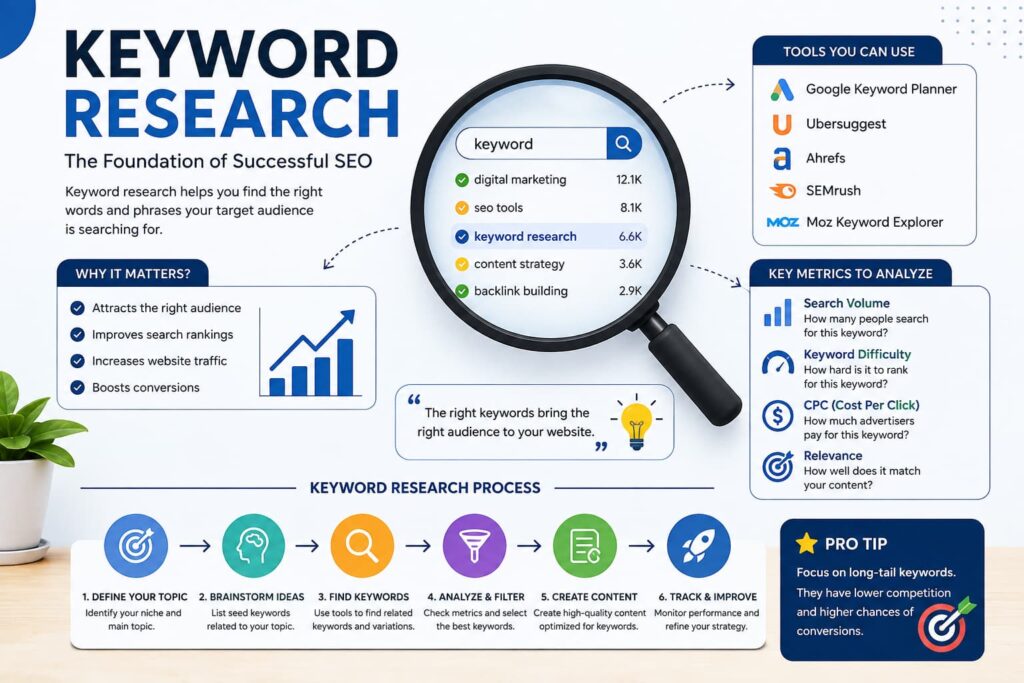
Keyword research is the process of finding and analyzing the KEY WORD research words and phrases that people enter into search engines KEY WORD like Google when looking for information, products, KEY WORD research or services. It is an important part keyword of SEO (Search Engine Optimization) because it helps us understand what our target audience is searching for
📝 Types of Keywords
These are longer and more specific KEY WORD search phrases.Creating great content is not enough in today’s world. Your content needs to be focused on what your users are looking for. One way to identify what your users are searching for is through keyword research. Keyword research involves gathering KEY WORD information about what people search for on the internet which will help you identify valuable keywords that you can use in your KEY WORD SEO campaign.
What is Keyword Research?
Keyword research is the process of gathering information about what people search for on the internet. Keywords are words or phrases that make content KEY WORD research relevant to users in a particular network, such as Google Search Engine and Yahoo! Site Explorer.
How do you gather information from Keyword Research? You will need to use various tools to help you find out valuable
Why is Keyword Research important for SEO?
Keyword research is important for KEY WORD because it helps identify what people are searching for. Keywords help you connect to your audience and give them the information they need. Keywords are important for Google and other search engines because they help them understand what your content is about.
Keyword research also helps you to answer questions like:
- How much competition will I have for this keyword?
- How many searches are happening for this keyword?
- What should I write about for this keyword?
- What is the user intent of people searching for this keyword and is it relevant to me?
Keyword research will save you time and effort when you are looking to attract new visitors to your website. Without doing your research, you are unlikely to succeed in today’s competitive world.
What Tools can I use for Keyword Research?
Competitors can be a great source of keyword ideas, but they might not be good at finding all the potential keywords. SEO tools are helpful in this regard because you can get tons more new ideas by plugging in seed keywords and pulling out relevant results from their databases.
Google Keyword Planner is perhaps the most well-known keyword tool. It’s free to use, and although it’s mainly for advertisers, you can also use it to find keywords for SEO as well. Beyond Keyword Planner, there are quite a few other free keyword research tools such as:
These are great if you’re on a budget, but you’ll quickly realize that they’re all very limited in their data and functionality since their goal is to convert you to a paying customer.
If you’re serious about keyword research, you may want to use a more advanced paid Keyword Research tool like Ahrefs’ Keywords Explorer or SEMRush Keyword Overview Tool.
What should I look for when doing keyword research?
The three most important factors to consider when choosing keywords are:
1. Keyword Relevance
Google ranks content for relevance. Search intent is about handing the searcher what they need in exchange for their time. Anything other than a friendly page that offers high-quality information to an interested party wo KEY WORD n’t rank well.
2. Keyword Authority
To rank in search engines, you need to be seen as an authoritative source. To achieve this goal, the onus is on you to create helpful and informative content for your site and promote that content by earning social signals- like Facebook shares or blog posts linking back to your website. But if a keyword’s SERPs are loaded with heavy sources (ex. Forbes) you may want to look for other, easier targets.
3. Keyword Volume
Your SEO strategy can be perfect but if you are not targeting the right keywords, your efforts will be lost. Ranking on the first page for a specific keyword with no search volume does you no good.
Volume is typically measured by monthly search volume (MSV). MSV is the number of times the keyword is searched per month across all audiences.
Some food for thought when you start your Keyword Research
The best keywords for your SEO strategy will factor in relevance, authority, and volume. You want to find highly searched keywords that you feel you can compete against based on the following criteria
- How difficult the keyword is to rank for (ie. whats your competition)
- Your ability to produce content that outranks what’s currently in the first spot.
Have you found yourself stuck in marketing hell? You know, when your website just isn’t cutting it. If this sounds all too familiar, fear not! Our web development team has the knowledge and expertise to create game-changing websites for businesses around the world. Let’s talk about your website today!
Search Engine Optimization (SEO)
Examples:
key word research plays a vital role in Keyword research is important in SEO because it helps you discover what people search for online, understand user intent, and drive targeted organic traffic. [1, 2, 3]
Audience Connection
Match user intent: Discover if users want information, a product, or a specific website.
Find exact terms: Learn the real words people type into search engines.
- How to do keyword research for SEO
- Best keyword research tools for beginners
- How to find keywords for a website
Long-tail keywords generally have lower search volume but can be easier to target and may better match a specific search intent.
2. Long-Tail Keywords
These are more specific phraseskeyword containing several words.
Example: digital marketing courses for beginners
3. Informational Keywords
Users search these keywords to find information.
Example: what is keyword research
4. Commercial Keywords
Users are researching products or services before making a decision.
Example: best SEO tools
5. Transactional Keywords
Users have an intention to take an actionkeyword, such as buying or signing up.
Example: buy SEO course online
🛠️ Keyword Research Process
- Identify your topic
- Understand your target audience
- Create a list of relevant keywords
- Check search volume and competition
- Analyze search intent
- Choose the most relevant keywords
- Use keywords naturally in your content
- Monitor and update your keywords regularly
🧰 Popular Keyword Research Tools
- Google Keyword Planner
- Google Trends
- Semrush
- Ahrefs
- Ubersuggest
- Google Search Console
✅ Conclusion
Keyword research is the foundation of an effective SEO strategy. By choosing the right keywords and understanding what users are searching for, businesses can create better content, improve their search engine rankings, and attract the right audience.Core Steps in Keyword-Driven Content Research
Cluster your keywords: Group related searchkeyword terms together into main topics
Find seed keywords: Brainstorm basic words or broad topics related to your niche or business.
Use research tools: Plug your seed words into platforms like Google Keyword Planner, SEMrush, or Ahrefs to generate lists.
Analyze key metrics: Check monthly search volume (how many look it up) and keyword difficulty (how hard it is to rank).
Understand search intent: Figure out if users want quick facts, deep guides, or products to buy, then shape your text to fit.
| SEO Component |
| Keyword Research |
keyword research improves the crawlability mobile usability builds websites

the process of finding the exact words and phrases people type into search engines. It helps you discover what your audience wants, how many people search for it, and how hard it is to rank for it. This data guides your writing so you create text people actually want to read. [1, 2, 3, 4]Key Steps for Effective Keyword Research
Insert chosen keywords naturally into your titles
Brainstorm broad core topics relevant to your niche or business.
Use research platforms like Ahrefs Free Keyword Tool or AnswerThePublic to find related terms and questions.
Focus on long-tail keywords (phrases with 3+ words) because they have clearer intent and lower competition.
Analyze search intent to see if users want an informational guide, a product review, or a purchasing page.
Group similar keywords into clusters to plan out structured blog posts or pillar pages.
| Purpose | |
| Identifies the terms and phrases users search for. | |
| On-Page SEO | Optimizes titles, headings, meta descriptions, URLs, images, and content. |
| Technical SEO | Improves site speed, crawlability, indexing, and mobile usability. |
| Off-Page SEO | Builds website authority through quality backlinks and brand mentions. |
| Local SEO | Helps businesses appear in location-based searches and Google Maps results. |
| Content SEO | Creates valuable, informative, and engaging content that satisfies user intent. |
Benefits of SEO
SEO offers numerous long-term advantages for businesses KEY WORD of all sizes. It increases website visibility, generates high-quality organic traffic, improves brand credibility, and delivers a higher return on investment compared to many traditional marketing methods. Because users often trust organic search results more than paid advertisements, ranking well can significantly enhance customer confidence. SEO also supports keywordother digital marketing channels by providing valuable content that can be shared through social media, email campaigns, and other platforms. KEYWORD
Another significant advantage is sustainabilitykeyword. While paid advertising stops generating traffic when the budget runs out, well-optimized content can continue attracting visitors for months or even years. Regularly updating content, monitoring keyword performance, and adapting to search engine KEY WORD algorithm changes help maintain strong rankings over time. As search technology continues to evolve with AI-driven experiences and conversational search, businesses that prioritize KEYWORD high-quality content, excellent user experience, and technical excellence will remain well-positioned to achieve long-term online success.
CONTINUE
On-Page SEO
On-Page SEO refers to all the optimization techniques applied directly to keywordindividual web pages to improve their visibility in search engines and enhance the user experience. It is one of the most important aspects of SEO because it helps search engines KEY WORD understand what a page is about and determine whether it matches a user’s search intent. Unlike off-page SEO, which focuses on external factors such as backlinks, on-pagekeyword SEO gives website owners complete control over how their content is structured and presented.

A well-optimized page starts with thorough keyword research. The primary keyword should naturally appear in the page title, URL, meta description, first paragraph, headings, and throughout the content without excessive repetition. Search engine KEY WORD s have become increasingly sophisticated, so stuffing a page KEY WORD with keywords no longer improves rankings and may even lead to penalties. Instead, content should include related keywords, synonyms, and semantic phrases that help search engines understand the broader topic.

Creating high-quality content is the foundation KEY WORD of on-page SEO. Every article should answer users’ questions clearly, provide accurate information, and offer unique insights. Long-form content generally performs better because it covers topics comprehensively, but quality should always take precedence over quantity. Breaking content into logical sections with descriptive headings (H2, H3, and H4) improves readability for both users and search engines.Keyword research is the process of finding and analyzing the words and phrases that people type into search engines such as Google when they are looking for information, products, or services.
For example, if someone wants to learn digital marketing, they may search:
- Digital marketing course
- What is digital marketing?
- SEO techniques
- Keyword research tools
- How to do keyword research
These search terms are called keywordsKeyword research is one of the most important parts of SEO (Search Engine Optimization).
It helps you:

.
Understand your audience – Know what people are searching for.
Create useful content – Write content that answers users’ questions.
Improve Google rankings – Target relevant search terms.
Increase website traffic – Bring more visitors to your website.
Find new content ideas – Discover topics people are interested in.
Understand search intent – Know what users actually want.
Reach the right audience – Attract people who are interested in your product or service.
Keyword research helps businesses understand what their target audience is searching for and create content that matches those searches.
Another critical factor is meta optimization. A compelling title tag encourages KEY WORD users to click on your page, while a well-written meta description summarizes the content and improves click-through rates. URLs should be short, descriptive, and include relevant keywords whenever possible.
Images also contribute to SEO. Every image should have a descriptive filename and alt text, helping search engines understand the image while improving accessibility for visually impaired users. Compressing images reduces page load time, which is another ranking factor.
Internal linking strengthens website KEYWORD research architecture by connecting related pages, making it easier for users and search engine crawlers to navigate the site. External links to reputable sources can also improve content credibility.
Best Practices for On-Page SEO
- Write unique and valuable content.
- Use one primary keyword and several related keywords naturally.
- Optimize title tags and meta descriptions.
- Structure content KEY WORD using proper headings.
- Add descriptive alt text to images. KEY WORD
- Improve page loading speed.
- Make pages mobile-friendly.
- Include internal and external links where appropriate.
Technical SEO
Technical SEO focuses on optimizing the infrastructure of a website so that search KEY WORD engines can crawl, index, and understand its content efficiently. Even the best-written content may struggle to rank if technical issues prevent search engines from accessing it. Technical SEO ensures that a website performs well, loads quickly, and provides a KEY WORD seamless experience across all devices.
One of the most important elements of technical SEO is website speed. Slow-loading websites frustrate users and increase bounce rates, which can negatively affect rankin
A well-optimized page starts with thorough keyword research. The primary keyword should naturally appear in the page title, URL, meta description, first paragraph, headings, and throughout the content without excessive repetition. Search engines have become increasingly sophisticated, so stuffing a page with keywords no longer improves rankings and may even lead to penalties. Instead, content should include related keywords, synonyms, and semantic phrases that help search engines understand the broader topic.
Creating high-quality content is the foundation of on-page SEO. Every KEY WORD article should answer users’ questions clearly, provide accurate information, and offer unique insights. Long-form content generally performs better because it covers topics comprehensively, but quality should always take precedence over quantity. Breaking content into logical sections with descriptive headings (H2, H3, and H4) improves readability for both users and search engines.
Another critical factor is meta optimization. KEY WORD A compelling title tag encourages users to click on your page, while a well-written meta description summarizes the content and improves click-through rates. URLs should be short, descriptive, and include relevant keywords whenever possible.
Images also contribute to SEO. KEY WORD Every image should have a descriptive filename and alt text, helping search engines understand the image while improving accessibility for visually impaired users. Compressing images reduces page load time, which is another ranking factor.
Internal linking strengthens website architecture by connecting related pages, making it easier for users and search engine crawlers to navigate the site. External links to reputable sources can also improve content credibility.
Best Practices for On-Page SEO
Technical SEO
Technical SEO focuses on optimizing the infrastructure of a website so that search engines can crawl, index, and understand its content efficiently. Even the best-written content may struggle to rank if technical issues prevent search engines from accessing it. Technical SEO ensures that a website performs well, loads quickly, and provides a seamless experience across all devices.
One of the most important elements of technical SEO is website speed. Slow-loading websites frustrate users and increase bounce rates, which can negatively affect rankings. Optimizing images, enabling browser caching, minimizing CSS and JavaScript files, and using a Content Delivery Network (CDN) can significantly improve loading times.
Mobile optimization has become essential KEY WORD because the majority of internet users browse websites on smartphones and tablets. Search engines use mobile-first indexing, meaning they primarily KEY WORD evaluate the mobile version of a website when determining rankings. Responsive web design ensures that a website looks and functions well on all screen sizes.
A secure website using HTTPS encryption KEY WORD is another ranking factor. HTTPS protects user data and builds trust by encrypting communication between the user’s browser and the website. KEY WORD Visitors are more likely to stay on a secure site, especially when making purchases or submitting personal information.

Technical SEO also involves creating and maintaining an XML sitemap, which helps search engine KEYWORD discover important pages. A properly configured robots.txt file tells search engine crawlers which pages they should or should not access.
Another important aspect is structured data (Schema Markup). Structured data helps search engines understand content more accurately and may result in rich snippets, such as starKEYWORD ratings, FAQs, recipes, product information, and event details appearing directly in search results.
Regular technical audits help identify issues such as broken links KEY WORD , duplicate conten KEY WORD t, redirect chains KEY WORD , crawl errors, KEY WORD and indexing problems before they affect search performance.
Technical SEO Checklist

| Task | Benefit |
| Improve Page Speed | Better user experience and rankings |
| Use HTTPS | Enhanced security and trust |
| Mobile-Friendly Design | Supports mobile-first indexing |
| XML Sitemap | Helps search engines discover pages |
| Robots.txt | Controls crawler access |
| Structured Data | Enables rich search results |
| Fix Broken Links | Improves crawlability |
| Optimize Core Web Vitals | Enhances page performance |
Technical SEO lays the groundwork for successful organic growth. Combined with high-quality content and strong authority-building efforts, it helps websites achieve sustainable KEY WORD visibility and improved KEY WORD rankings in search engine results.
Get smarter responses, upload files and images,